Dr. Laia Soler, former PhD researcher under the supervision of Prof. Xavier Obradors and Dr. Susagna Ricart defended her PhD thesis entitled Liquid-assisted ultrafast growth of superconducting films derived from chemical solutions publicly on 1 March 2019 at the ICMAB-CSIC Auditorium.
Our PhD student Laia Soler Bru will defend her PhD thesis on Friday, 1 March 2019, at 11 am at ICMAB-CSIC. Liquid-assisted ultrafast growth of superconducting films derived from chemical solutions
Hola! We are Diana and Lavinia, the new PhD students. We are both chemists and we recently started our work in the field of superconductivity in SUMAN group.
Even though one of us is from Barcelona (Diana) and the other one is from Rome (Lavinia), we got to know each other last year during our Master Thesis carried out in the same research group in UAB.
We are happy to be part of the group and looking forward to working with all of you!
Hi! My name is Jordi and I am from Reus. Last year I did an internship here at ICMAB for my Master Thesis working on Hybrid Magnetic-Superconducting devices under the supervision of Dr. Anna Palau. Now I have joined the SUMAN group as a Project PhD student working on the advanced physical and structural characterizations of the YBCO films in Resisitive Switching and in the EUROFUSION project under the supervision of Dr. Anna Palau and Dr. Narcís Mestres.
I like science, playing all kind of sports but basketball in particular and going to the mountain in order to relax and enjoy the nature.
I am really glad to be part of this team and I hope to learn, help and have fun with you!
A fast and single‐step preparation of patchy LnF3 faceted‐charge nanocrystals are described. These hexagonal faceted nanocrystals allow the spontaneous selective adsorption of cations or anions in the different faces, producing stable and well‐defined patches of different charge. The mechanism for the formation of the patches and the properties of the obtained nanocrystals were characterized by a combination of experimental techniques and all‐atomic molecular dynamics simulations. The spontaneous dual‐charged surface as well as the luminescence effects that can be achieved by doping host–LaF3 systems make these new nanocrystals interesting both from a fundamental point of view and for a wide range of applications.
Modulation of carrier concentration in strongly correlated oxides offers the unique opportunity to induce different phases in the same material, which dramatically change their physical properties, providing novel concepts in oxide electronic devices with engineered functionalities. This work reports on the electric manipulation of the superconducting to insulator phase transition in YBa2Cu3O7−δ thin films by electrochemical oxygen doping. Both normal state resistance and the superconducting critical temperature can be reversibly manipulated in confined active volumes of the film by gate-tunable oxygen diffusion. Vertical and lateral oxygen mobility may be finely modulated, at the micro- and nano-scale, by tuning the applied bias voltage and operating temperature thus providing the basis for the design of homogeneous and flexible transistor-like devices with loss-less superconducting drain–source channels. We analyze the experimental results in light of a theoretical model, which incorporates thermally activated and electrically driven volume oxygen diffusion.
José M. Vila-Fungueiriño, Andres Gomez, Jordi Antoja-Lleonart, Jaume Gazquez, César Magén, Beatriz Noheda and Adrian Carretero-Genevrier. Nanoscale, 2018
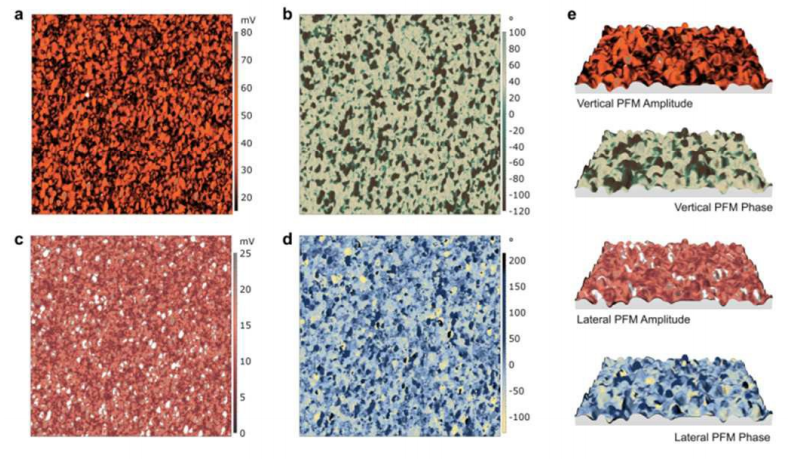
We use an original water-based chemical method, to grow pure epitaxial BiFeO3 (BFO) ultra-thin films with excellent piezoelectric properties. Particularly, we show that this novel chemical route produces a higher natural ferroelectric domain size distribution and coercive field compared to similar BFO films grown by physical methods. Moreover, we measured the d33 piezoelectric coefficient of 60 nm thick BFO films with a direct approach, using Direct Piezoelectric Force Microscopy (DPFM). As a result, first piezo-generated charge maps of a very thin BFO layer were obtained applying this novel technology. We also performed a comparative study of the d33 coefficients between standard PFM analysis and the DPFM microscopy showing similar values i.e. 17 pm/V and 22 pC/N respectively. Finally, we proved that the directionality of the piezoelectric effect in BFO ferroelectric thin films is preserved at low thickness dimensions demonstrating the potential of chemical processes for the development of low cost functional ferroelectric and piezoelectric devices.
Teresa Puig was on November 15, 2018, on the radio! The program “La Nit Estèrica” from Terrassa Digital (95.2 FM)interviewed Teresa Puig, ICMAB researcher from Terrassa. They talked about superconducting materials and about the begining of Teresa Puig in the superconducting world, about her current projects, and many more things!
Listen to the interview here, from mintue 10:00!
The following article appeared in the ERC Newsletter on 26 October 2018. It is about the project #LasCientíficasCuentan, which explalins complex science through the voice of fifteen female ERC grantees in Spain. From ICMAB, Teresa Puig and Marta Mas-Torrent participated in the project, funded by the FECYT and the FGCSIC. They give talks, participate in roundtables, and appear in some videos explaining their research!