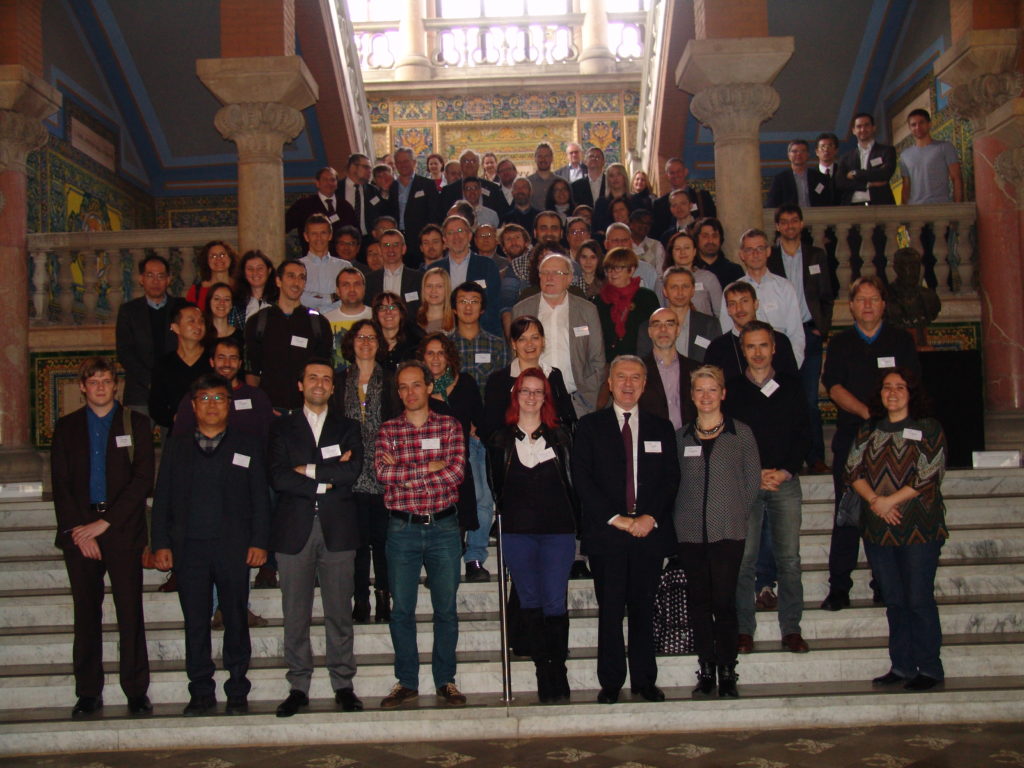
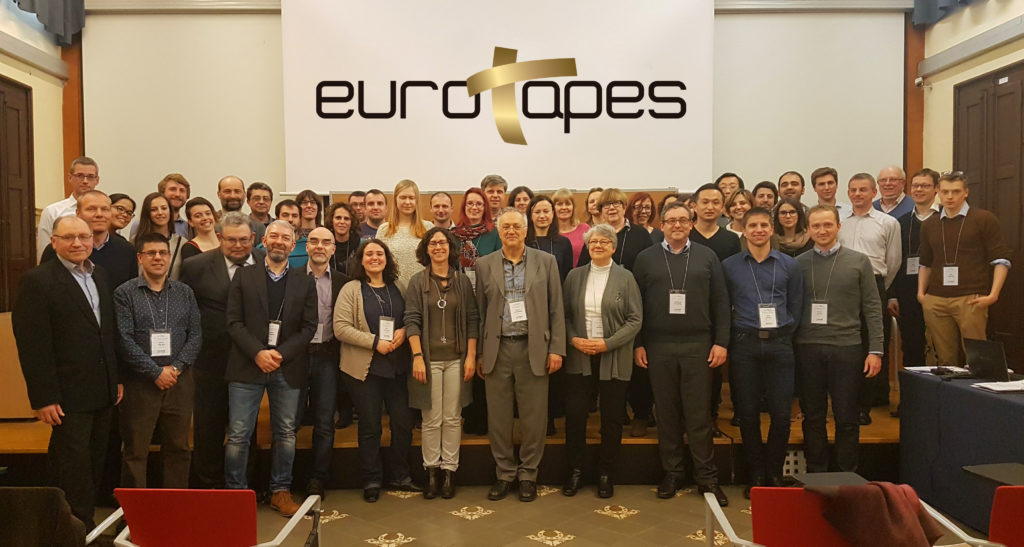
In the frame of EUROTAPES and EuCARD-2 EU projects, ICMAB-CSIC (Xavier Obradors – EUROTAPES Coordinator) and CERN (Lucio Rossi CERN – EuCARD2-WP10 Coordinator) have co-organized the the 4th Workshop on Accelerator Magnets in HTS (WAMHTS-4 ).
On 15th afternoon, during the common session of “EUROTAPES and EuCARD-2”, Prof. Xavier Obradors gave a talk entittled “Progress in the development of coated conductors in Europe” and Prof. Teresa Puig talk about “Progress in the development of nanostructured coated conductors through chemical processes (CSD)”.
During the workshop different partners from both consortiums explained their last developments realized on HTS conductors and different conductor industries (BRUKER, OXOLUTIA, THEVA, DNANO, SUPERPOWER, FUJIKURA, SUPEROX, SUNAM) presented their last results.
During these days we have organized the final meeting of EUROTAPES project (coordinated by Prof. Xavier Obradors) at Casa de la Convalescència at Barcelona. During the meeting it has been summarized all the progress done during these 4 years and a half within the consortium. A great success!
Thank you to all the partners! A big enthusiastic and successful team!
EL PERIÓDICO, DOMINGO, 12 DE FEBRERO DEL 2017 MICHELE CATANZARO
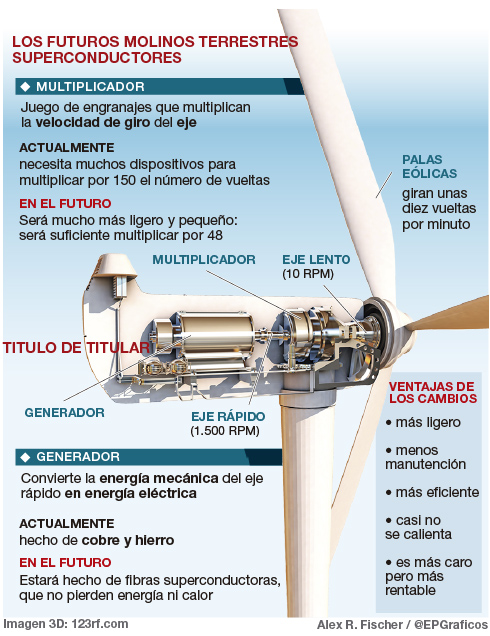
El cambio primordial en un molino superconductor está en el generador. “En lugar de cobre y hierro en su interior hay cintas de segunda generación, unos filamentos superconductores”, explica Xavier Obradors, director del Icmab. No solo los filamentos no pierden energía, sino que tampoco se calientan, por lo que no se necesita la maquinaria de enfriamiento que precisan los metales tradicionales.
Es cierto que hay que enfriarlos para que sean superconductores, pero los investigadores han diseñado un sistema eficiente que implica menos energía.
Albert Queraltó*, María de la Mata, Jordi Arbiol, Ruben Hühne∥, Xavier Obradors, and Teresa Puig. Cryst. Growth Des., 2017, 17 (2), pp 504–516. DOI: 10.1021/acs.cgd.6b01358
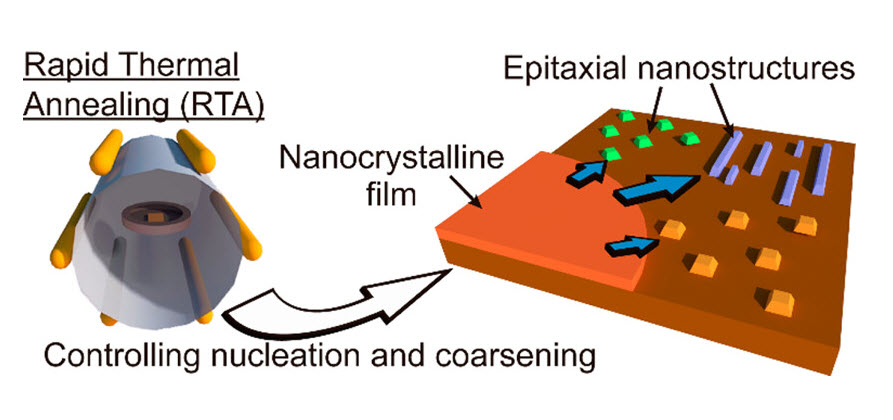
Self-assembling approaches based on chemical solution deposition (CSD) are ideal methods for the cost-effective production of epitaxial nanostructures with high throughput. Therefore, an in-depth investigation of the nucleation and coarsening processes involved in the self-assembly of nanostructures is mandatory to achieve a good control over nanostructure shape, dimensions, and orientation. Heteroepitaxial Ce0.9Gd0.1O2-y (CGO) is an ideal model system to unveil the underlying nanostructure development mechanisms in addition to their promising properties for catalysis, gas sensors, and ionic conductivity. Rapid thermal annealing furnaces have been used to study separately the thermodynamic and kinetic nucleation and coarsening mechanisms of self-assembled CGO isotropic and anisotropic nanostructures based on strain-engineering and surface energies control. Different CGO nanoislands are obtained: isotropic (001)CGO nanodots are grown on (001)-oriented Y2O3:ZrO2 (YSZ) and LaAlO3 (LAO) substrates, whereas (011)LAO substrates promote the growth of elongated (011)CGO nanowires. HRTEM and RHEED analyses are used to study the early stages of nucleation, as well as the shape and interfacial structure of CGO nanostructures. A systematic study with the heating ramp, annealing temperature and time, and strain in combination with thermally activated theoretical models provides information on the nucleation behavior, nucleation barriers, and atomic diffusion coefficients along in-plane and out-of-plane island orientations. Highly anisotropic atomic diffusion constants have been shown to be at the origin of the high aspect ratios of some of the nanostructures. Overall, our study provides a general method for the evaluation of nucleation and coarsening of multiple CSD-derived oxide nanostructures and understanding the shape development by combining thermodynamic and kinetic approaches.
Hi everyone! My name is Hailin Wang. I’m from China. I have a master degree in Inorganic Chemistry, and I come to ICMAB to do my PhD about functional oxide thin films under the supervision of Dr. Narcis Mestres and Dr. Benjamin Martinez.
In my spare time, I like reading, travelling and bicycling.
• The prototype is the first in the world to be used in medium-power wind turbines.
• The use of Superconducting materials simplifies the system obtaining greater reliability and greater efficiency thus reducing maintenance needs.
• This breakthrough opens the way to a new conception of wind turbines and offers a new perspective to the wind energy industry.
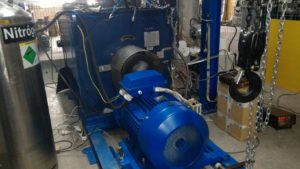
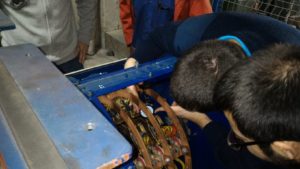
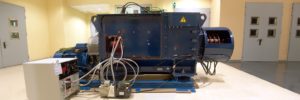
Monday, December 12, 2016. Gamesa Innovation and Technology, a leading Spanish technology company in the wind energy industry, the Institute of Materials Science of Barcelona (ICMAB-CSIC) and the Institute of Materials Science of Aragón (ICMA-CSIC), partially funded by the Spanish Ministry of Economy and Competitiveness (Retos Colaboración RTC-2014-1740-3), have successfully completed the first phase of development of the first medium speed Superconducting generator to be used in conventional medium power wind turbines (2MW).
It is a generator that, being built using Superconducting materials, can rotate at a lower rotation speed (one third of the usual) thus reducing the weight of the multiplier gearbox significantly as well as the inertia of the system simplifying and lightening all the mechanical assembly or drivetrain and the structure itself.
The electric Superconducting generator is the result of an innovative architecture with a lower use of cooper and an iron-less magnetic circuit which results in a greater efficiency and, consequently, a much lower generation of heat thus drastically reducing cooling requirements.
The advantages of this new type of electric generator that uses Superconducting materials compared to the conventional generators are diverse: it simplifies the entire mechanical structure of the wind turbine as well as the electronic system; simplifies assembly and maintenance, reduces the risk of breakdowns; the time of intervention for maintenance is extended; and, in the near future, the cost will be reduced according to the rapid evolution of Superconducting materials.
The future implementation of this type of electric Superconducting generator in the wind turbines opens a new perspective to the wind energy industry, making windmills more efficient and robust and reducing the costs of energy production.
After four years of intense collaboration between the three entities, the culmination of the first phase of the project in early 2016 with the successful construction of this prototype and the corresponding trials has become a clear success case of Technology Transfer from research in superconducting materials to its possible applications in the generation of wind energy.
ICMAB-CSIC, ICMA-CSIC and Gamesa Innovation and Technology continue to collaborate in order to carry out field trials to offer new innovative technological solutions in this sector.
Katrien De Keukeleere, Pablo Cayado, Alexander Meledin, Ferran Vallès, Jonathan De Roo, Hannes Rijckaert, Glenn Pollefeyt, Els Bruneel, Anna Palau, Mariona Coll, Susagna Ricart, Gustaaf Van Tendeloo, Teresa Puig, Xavier Obradors, Isabel Van Driessche. Advanced Electronic Materials. DOI: 10.1002/aelm.201600161
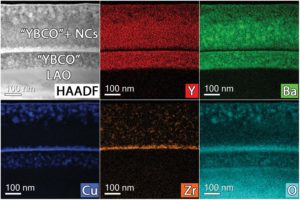
Although high temperature superconductors are promising for power applications, the production of low-cost coated conductors with high current densities—at high magnetic fields—remains challenging. A superior superconducting YBa2Cu3O7–δ nanocomposite is fabricated via chemical solution deposition (CSD) using preformed nanocrystals (NCs). Preformed, colloidally stable ZrO2 NCs are added to the trifluoroacetic acid based precursor solution and the NCs’ stability is confirmed up to 50 mol% for at least 2.5 months. These NCs tend to disrupt the epitaxial growth of YBa2Cu3O7–δ, unless a thin seed layer is applied. A 10 mol% ZrO2 NC addition proved to be optimal, yielding a critical current density JC of 5 MA cm−2 at 77 K in self-field. Importantly, this new approach results in a smaller magnetic field decay of JC(H//c) for the nanocomposite compared to a pristine film. Furthermore, microstructural analysis of the YBa2Cu3O7–δ nanocomposite films reveals that different strain generation mechanisms may occur compared to the spontaneous segregation approach. Yet, the generated nanostrain in the YBa2Cu3O7–δ nanocomposite results in an improvement of the superconducting properties similar to the spontaneous segregation approach. This new approach, using preformed NCs in CSD coatings, can be of great potential for high magnetic field applications.
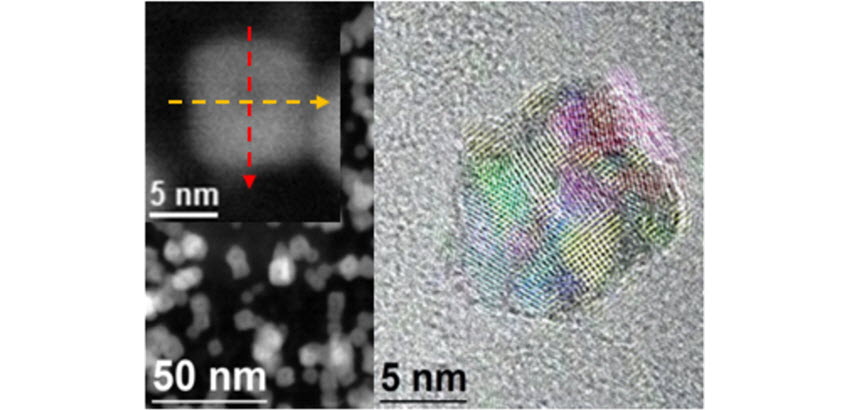
The fabrication procedure of hollow iron oxide nanoparticles with a large surface to volume ratio by a single-step gas condensation process at ambient temperature is presented. Fe clusters formed during the sputtering process are progressively transformed into hollow cuboids with oxide shells by the Kirkendall mechanism at the expense of oxygen captured inside the deposition chamber. TEM and Raman spectroscopy techniques point to magnetite as the main component of the nanocuboids; however, the magnetic behavior exhibited by the samples suggests the presence of FeO as well. In addition, these particles showed strong stability after several months of exposure to ambient conditions, making them of potential interest in diverse technological applications. In particular, these hierarchical hollow particles turned out to be very efficient for both As(III) and As(V) absorption (326 and 190 mg/g, respectively), thus making them of strong interest for drinking water remediation.








 • The prototype is the first in the world to be used in medium-power wind turbines.
• The use of Superconducting materials simplifies the system obtaining greater reliability and greater efficiency thus reducing maintenance needs.
• This breakthrough opens the way to a new conception of wind turbines and offers a new perspective to the wind energy industry.
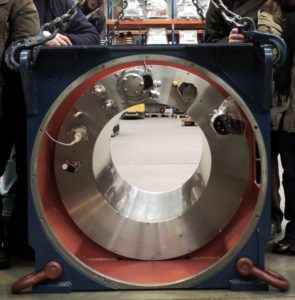
Monday, December 12, 2016. Gamesa Innovation and Technology, a leading Spanish technology company in the wind energy industry, the Institute of Materials Science of Barcelona (ICMAB-CSIC) and the Institute of Materials Science of Aragón (ICMA-CSIC), partially funded by the Spanish Ministry of Economy and Competitiveness (Retos Colaboración RTC-2014-1740-3), have successfully completed the first phase of development of the first medium speed Superconducting generator to be used in conventional medium power wind turbines (2MW).
It is a generator that, being built using Superconducting materials, can rotate at a lower rotation speed (one third of the usual) thus reducing the weight of the multiplier gearbox significantly as well as the inertia of the system simplifying and lightening all the mechanical assembly or drivetrain and the structure itself.
The electric Superconducting generator is the result of an innovative architecture with a lower use of cooper and an iron-less magnetic circuit which results in a greater efficiency and, consequently, a much lower generation of heat thus drastically reducing cooling requirements.
The advantages of this new type of electric generator that uses Superconducting materials compared to the conventional generators are diverse: it simplifies the entire mechanical structure of the wind turbine as well as the electronic system; simplifies assembly and maintenance, reduces the risk of breakdowns; the time of intervention for maintenance is extended; and, in the near future, the cost will be reduced according to the rapid evolution of Superconducting materials.
The future implementation of this type of electric Superconducting generator in the wind turbines opens a new perspective to the wind energy industry, making windmills more efficient and robust and reducing the costs of energy production.
After four years of intense collaboration between the three entities, the culmination of the first phase of the project in early 2016 with the successful construction of this prototype and the corresponding trials has become a clear success case of Technology Transfer from research in superconducting materials to its possible applications in the generation of wind energy.
ICMAB-CSIC, ICMA-CSIC and Gamesa Innovation and Technology continue to collaborate in order to carry out field trials to offer new innovative technological solutions in this sector.
• The prototype is the first in the world to be used in medium-power wind turbines.
• The use of Superconducting materials simplifies the system obtaining greater reliability and greater efficiency thus reducing maintenance needs.
• This breakthrough opens the way to a new conception of wind turbines and offers a new perspective to the wind energy industry.
Monday, December 12, 2016. Gamesa Innovation and Technology, a leading Spanish technology company in the wind energy industry, the Institute of Materials Science of Barcelona (ICMAB-CSIC) and the Institute of Materials Science of Aragón (ICMA-CSIC), partially funded by the Spanish Ministry of Economy and Competitiveness (Retos Colaboración RTC-2014-1740-3), have successfully completed the first phase of development of the first medium speed Superconducting generator to be used in conventional medium power wind turbines (2MW).
It is a generator that, being built using Superconducting materials, can rotate at a lower rotation speed (one third of the usual) thus reducing the weight of the multiplier gearbox significantly as well as the inertia of the system simplifying and lightening all the mechanical assembly or drivetrain and the structure itself.
The electric Superconducting generator is the result of an innovative architecture with a lower use of cooper and an iron-less magnetic circuit which results in a greater efficiency and, consequently, a much lower generation of heat thus drastically reducing cooling requirements.
The advantages of this new type of electric generator that uses Superconducting materials compared to the conventional generators are diverse: it simplifies the entire mechanical structure of the wind turbine as well as the electronic system; simplifies assembly and maintenance, reduces the risk of breakdowns; the time of intervention for maintenance is extended; and, in the near future, the cost will be reduced according to the rapid evolution of Superconducting materials.
The future implementation of this type of electric Superconducting generator in the wind turbines opens a new perspective to the wind energy industry, making windmills more efficient and robust and reducing the costs of energy production.
After four years of intense collaboration between the three entities, the culmination of the first phase of the project in early 2016 with the successful construction of this prototype and the corresponding trials has become a clear success case of Technology Transfer from research in superconducting materials to its possible applications in the generation of wind energy.
ICMAB-CSIC, ICMA-CSIC and Gamesa Innovation and Technology continue to collaborate in order to carry out field trials to offer new innovative technological solutions in this sector.

 Katrien De Keukeleere, Pablo Cayado, Alexander Meledin, Ferran Vallès, Jonathan De Roo, Hannes Rijckaert, Glenn Pollefeyt, Els Bruneel, Anna Palau, Mariona Coll, Susagna Ricart, Gustaaf Van Tendeloo, Teresa Puig, Xavier Obradors, Isabel Van Driessche. Advanced Electronic Materials.