Dr. Luisa CHIESA_ICMAB Lecture_8th NOVEMBER
Dear friends and colleagues,
It is a pleasure for us invite you to the ICMAB Lecture entitled:
“High temperature superconductors: how do we go from a single HTS tape to its deployment in high-field magnets and large scale applications?”
By Dr. Luisa CHIESA
Mechanical Engineering Department, Tufts University, Medford, MA, USA
Date: 8th NOVEMBER
Time: 12:00 h
Place: ICMAB Meeting room
Short abstract: After 25 years of development, several high temperature superconductors (HTS) are becoming engineering materials commercially available in long-length wires. Those conductors are capable of carrying enormous electrical current in strong magnetic fields while meeting various other challenges. Such characteristics enable the construction of a broad spectrum of devices useful for basic science, medicine, and energy.
In this talk, the state-of-art manufacturing, properties and challenges of key HTS conductors will be discussed with particular focus on REBCO coated conductors. The electrical, magnetic, and mechanical properties and failure mechanisms important for constructing devices will be discussed and examples of large scale projects employing those materials will be given to illustrate the positive impact those new materials could have in future generation’s magnets.
Further details will be given to HTS tape cabling methods for these magnet applications. To improve fabrication methods and maximize operational performance of these cables, it is necessary to characterize both the electromechanical behavior of the full scale cables and of the individual tapes under anticipated thermal, mechanical and electromagnetic loads. Some laboratory experimentation and structural finite element analysis (FEA) that have been used to investigate the electromechanical behavior of single HTS tapes and Twisted Stacked-Tape Cable (TSTC) conductors will be discussed. The numerical and experimental results discussed in this talk, provide important details about the strain dependence of the critical current for various load types expected during high field magnet operations.
Short bio— Luisa Chiesa is an associate professor at Tufts University. Before joining the faculty at Tufts in 2009, Dr. Chiesa received her Ph.D. in Nuclear Science and Engineering at MIT and her bachelor in
Physics from the Universita’ Statale in Milan (Italy). Dr. Chiesa worked in the field of superconducting magnets for the past 15 years. After a year as a visiting student at Fermilab working on quench protection for the LHC quadrupoles, she joined the Superconducting Magnets group at LBNL where she was heavily involved in the experimental characterization of high field superconducting magnets.
Currently, her primary research area is the electro-mechanical characterization of low temperature and high temperature superconductors for large magnets used in high-energy physics and fusion power devices. In particular her laboratory specializes in experimental and numerical techniques to characterize the critical current of superconducting strands, tapes and cables under different mechanical loading conditions. Dr. Chiesa is an active member of the IEEE Council on Superconductivity and serves as technical editor on the IEEE Transaction on Applied Superconductivity journal and as board member of major conferences in the field of superconductivity.
If you would like to arrange a meeting with her please contact:
Prof. Teresa PUIG (teresa.puig@icmab.es) or Dr. Mar TRISTANY (mtristany@icmab.es)
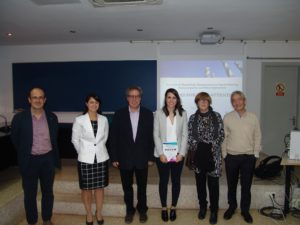 Congratulation to Alba Garzón for obtaining her PhD!
Tittle: SYNTHESIS OF METAL OXIDE NANOPARTICLES FOR SUPERCONDUCTING NANOCOMPOSITES AND OTHER APPLICATIONS
Abstract: Thermal and microwave methodologies are used to synthesize different metal oxides nanoparticles such as magnetite (Fe3O4) and cerium oxide (CeO2). By modifying the precursors (Fe(R2diket)3 (R= Ph, tBu and CF3), Ce(acac)3 and Ce(OAc)3), and following the same synthetic route, it is possible to control the size and shape of the nanocrystals obtained. The general route is carried out in triethylene glycol (TREG) or benzyl alcohol (BnOH) media, due to its high boiling point and, which acts also as a capping ligand of the nanoparticles, stabilizing them in polar solvents.
Nanoparticles have been characterized by several common physical laboratory techniques: High Resolution Transmission Electron Microscopy (HR TEM), infrared spectroscopy (IR), X-ray Powder Diffraction (XRPD), magnetometry via Superconducting Quantum Interference Device (SQUID), Nuclear Magnetic Resonance (RMN), Gas Chromatography-Mass Spectroscopy (GC-MS), X-ray Photoelectron Spectroscopy (XPS) and Thermogravimetric Analysis (TGA). With all these techniques, the final size, shape, composition, crystal structure, magnetic behaviour and capping ligand interaction have been studied, showing the high quality crystals generated. In addition, we demonstrate the high efficiency of all two one-pot methodologies optimized to synthesize different families of nanoparticles in a reproducible way.
The stable colloidal solutions obtained in methanol have been used to generate new nanocomposite YBa2Cu3O7-δ (YBCO) superconducting layers by the preformed nanoparticles (ex-situ) approach. The YBCO nanocomposite layers present enhanced magnetic properties.
Finally, a new application as an antioxidant behaviour in human cells is tested for the case of CeO2 nanoparticles due to their specifically properties that make them really interested in this new field.
Date and place: 4th November 2016. Sala de Graus Dept. Química UAB
Congratulation to Alba Garzón for obtaining her PhD!
Tittle: SYNTHESIS OF METAL OXIDE NANOPARTICLES FOR SUPERCONDUCTING NANOCOMPOSITES AND OTHER APPLICATIONS
Abstract: Thermal and microwave methodologies are used to synthesize different metal oxides nanoparticles such as magnetite (Fe3O4) and cerium oxide (CeO2). By modifying the precursors (Fe(R2diket)3 (R= Ph, tBu and CF3), Ce(acac)3 and Ce(OAc)3), and following the same synthetic route, it is possible to control the size and shape of the nanocrystals obtained. The general route is carried out in triethylene glycol (TREG) or benzyl alcohol (BnOH) media, due to its high boiling point and, which acts also as a capping ligand of the nanoparticles, stabilizing them in polar solvents.
Nanoparticles have been characterized by several common physical laboratory techniques: High Resolution Transmission Electron Microscopy (HR TEM), infrared spectroscopy (IR), X-ray Powder Diffraction (XRPD), magnetometry via Superconducting Quantum Interference Device (SQUID), Nuclear Magnetic Resonance (RMN), Gas Chromatography-Mass Spectroscopy (GC-MS), X-ray Photoelectron Spectroscopy (XPS) and Thermogravimetric Analysis (TGA). With all these techniques, the final size, shape, composition, crystal structure, magnetic behaviour and capping ligand interaction have been studied, showing the high quality crystals generated. In addition, we demonstrate the high efficiency of all two one-pot methodologies optimized to synthesize different families of nanoparticles in a reproducible way.
The stable colloidal solutions obtained in methanol have been used to generate new nanocomposite YBa2Cu3O7-δ (YBCO) superconducting layers by the preformed nanoparticles (ex-situ) approach. The YBCO nanocomposite layers present enhanced magnetic properties.
Finally, a new application as an antioxidant behaviour in human cells is tested for the case of CeO2 nanoparticles due to their specifically properties that make them really interested in this new field.
Date and place: 4th November 2016. Sala de Graus Dept. Química UAB

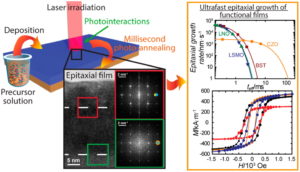

 ¡Hola todos, Soy Pengmei Yu de China, y un placer conoceros!
My background is light chemical engineering, and I’ll be working here for my PhD degree for the next 4 years, under the supervision of Dr. Mariona Coll.
In my spare time, I like to do some readings, listening to music, playing badminton and hiking.
¡Hola todos, Soy Pengmei Yu de China, y un placer conoceros!
My background is light chemical engineering, and I’ll be working here for my PhD degree for the next 4 years, under the supervision of Dr. Mariona Coll.
In my spare time, I like to do some readings, listening to music, playing badminton and hiking.

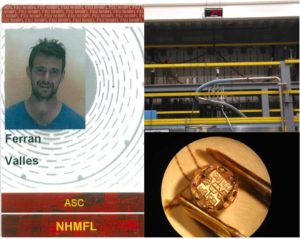 The PhD candidate Ferran Vallès has been visiting the Applied Superconductivity Center (ASC) in Tallahassee (Florida, USA) from the
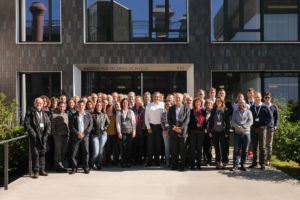

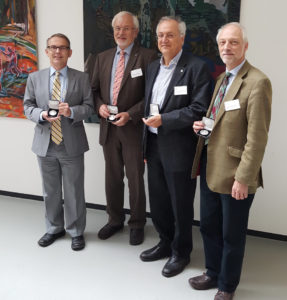 In the picture (from left to right): Prof. Philippe M. Fauchet, Vanderbilt Univ., Prof. Eberhard Umbach, KIT, Prof. Xavier Obradors Berenguer, ICMAB-CSIC, Prof. Alan Lindsay Greer, Univ. of Cambridge.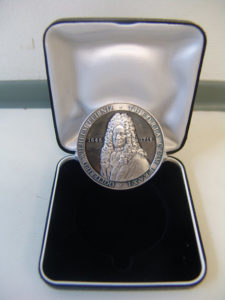

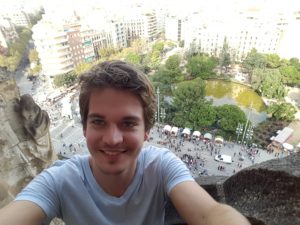 “Hello everyone! My name is Marijn van de Putte and I am a student from the University of Twente in the Netherlands. After completing my Bachelor in Advanced Technology I am now following a Master in Nanotechnology. Here at ICMAB I am doing an internship for this master program and together with Dr. Narcis Mestres I will be doing research into barium manganese nanowires. I am looking forward to work here and enjoy my time here to the fullest!”

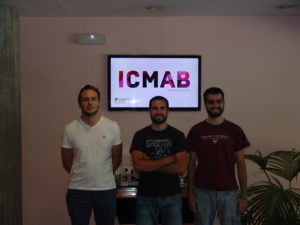 Sebastiaan de Vrieze, master student of Ghent University. From february to june 2016 he has been doing a short stay in “Superconducting Materials and Large Scale Nanostructures” group at ICMAB (in collaboration with UAB) untitled “Synthesis , deposition and characterization of ex-situ nanocomposite YBCO layers containing ZrO2 and HfO2 Nanoparticles” under the supervision of Dr. Susagna Ricart.
Alejandro Fernández Rodríguez, student of the master “Advanced nanoscience and nanotechnology” at Universidad Autónoma de Barcelona (UAB). From January to July 2016 he had been doing his master thesis in “Superconducting Materials and Large Scale Nanostructures” group at ICMAB. The title is “Tuning the electronic structure in high temperature superconducting films” and it was directed by Dr. Anna Palau.
Juan Carlos Martin Romano, from Madrid, He is a chemist graduated as of last year. He is currently doing the UAB Master on Advanced Nanoscience and Nanotechnology, which has given me the opportunity to get to know Barcelona. He has been doing his master thesis under the supervision of Dr. Mariona Coll in the group of Superconducting Materials. The theme is the engineering of perovskite materials to be applied in the field of photovoltaic energy.
Isabel García Pon
Sebastiaan de Vrieze, master student of Ghent University. From february to june 2016 he has been doing a short stay in “Superconducting Materials and Large Scale Nanostructures” group at ICMAB (in collaboration with UAB) untitled “Synthesis , deposition and characterization of ex-situ nanocomposite YBCO layers containing ZrO2 and HfO2 Nanoparticles” under the supervision of Dr. Susagna Ricart.
Alejandro Fernández Rodríguez, student of the master “Advanced nanoscience and nanotechnology” at Universidad Autónoma de Barcelona (UAB). From January to July 2016 he had been doing his master thesis in “Superconducting Materials and Large Scale Nanostructures” group at ICMAB. The title is “Tuning the electronic structure in high temperature superconducting films” and it was directed by Dr. Anna Palau.
Juan Carlos Martin Romano, from Madrid, He is a chemist graduated as of last year. He is currently doing the UAB Master on Advanced Nanoscience and Nanotechnology, which has given me the opportunity to get to know Barcelona. He has been doing his master thesis under the supervision of Dr. Mariona Coll in the group of Superconducting Materials. The theme is the engineering of perovskite materials to be applied in the field of photovoltaic energy.
Isabel García Pon cet , 4th-year-student of Nanocsience and Nanotechnology degree at Universitat Autònoma de Barcelona. She has been doing her final degree thesis thesis in the group of Supercondu cting Materials and Nanostructure at Large Scale at ICMAB under the supervision of Dr. Susagna Ricart concerning the synthesis and characterization of YBCO superconductor layers.
Pamela Ma
cet , 4th-year-student of Nanocsience and Nanotechnology degree at Universitat Autònoma de Barcelona. She has been doing her final degree thesis thesis in the group of Supercondu cting Materials and Nanostructure at Large Scale at ICMAB under the supervision of Dr. Susagna Ricart concerning the synthesis and characterization of YBCO superconductor layers.
Pamela Ma chado is in her last year of Nanoscience and Nanotechnology degree in the Autonomous University of Barcelona. She has been doing her final degree thesis in the group of Superconducting Materials and Nanostructure at Large Scale under the supervision of Dr. Mariona Coll. She worked with a perovskite ferroelectric material and studied its electrical and optical properties to apply it to photovoltaic devices.
 Orjan Artursson, he comes from Sweden and he is Project Engineer. He will be in charge of the installation of the new lab of the group in MATGAS building.
 Roger Guzman, after a first postdoc in Zaragoza he comes back to the group to work as a postdoc in STEM and EELS characterization of YBCO nanocomposites samples.
 Flavio Pino, he comes from Italy and he is joining us as a postdoc to work on the inkjet deposition and UV curing of superconducting thick films.
 Juri Banchewsky, he comes from Germany and he is starting his PhD in the group concerning Vortex pinning studies in YBCO nanocomposites samples.