Disentangling vortex pinning landscape in chemical solution deposited superconducting YBa2Cu3O7−x films and nanocomposites
A Palau, F Vallès, V Rouco, M Coll, Z Li, C Pop, B Mundet, J Gàzquez, R Guzman, J Gutierrez, X Obradors and T Puig. Superconductor Science and TechnologyVolume 31Number 3https://doi.org/10.1088/1361-6668/aaa65e

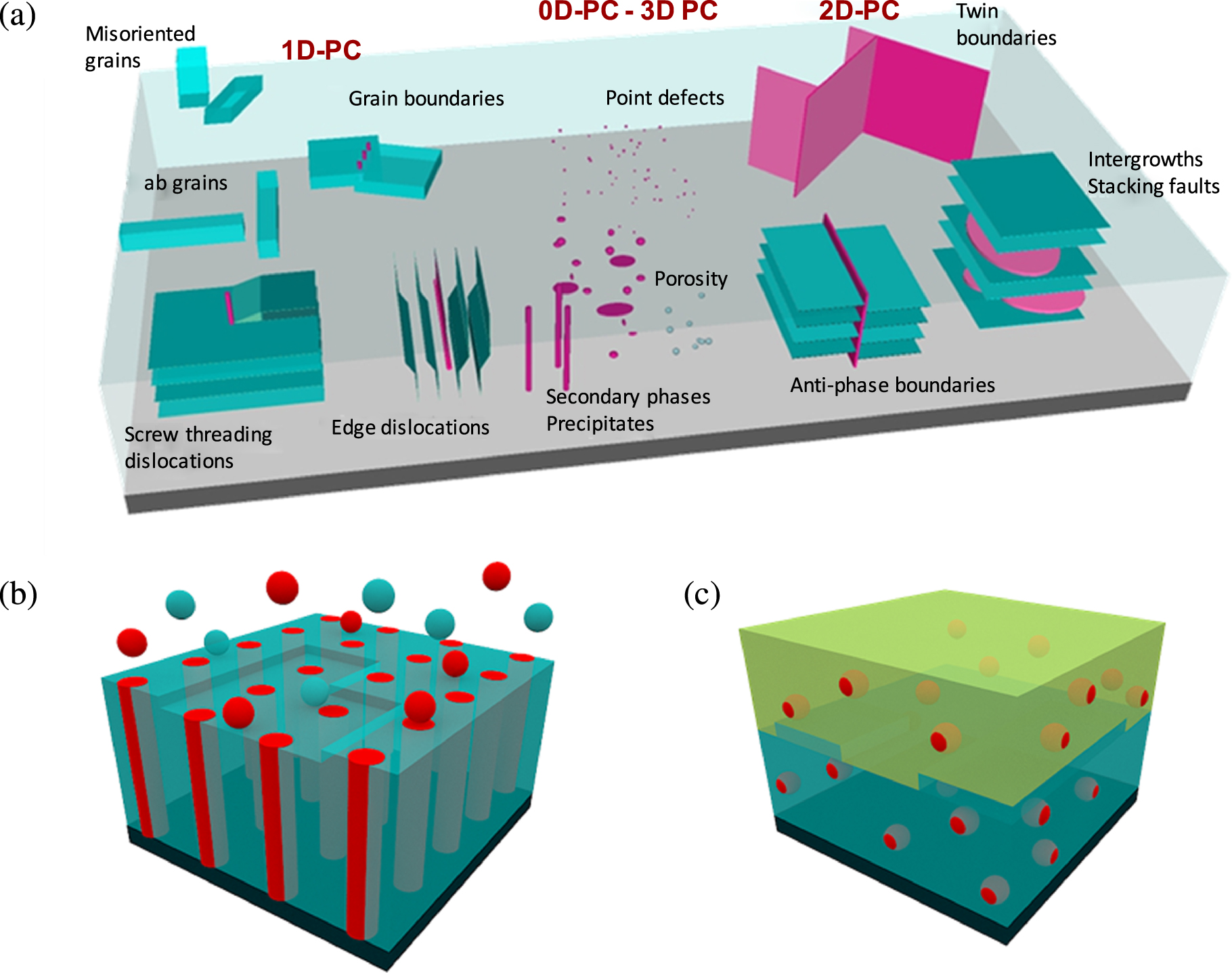
In-field angular pinning performances at different temperatures have been analysed on chemical solution deposited (CSD) YBa2Cu3O7−x (YBCO) pristine films and nanocomposites. We show that with this analysis we are able to quantify the vortex pinning strength and energies, associated with different kinds of natural and artificial pinning defects, acting as efficient pinning centres at different regions of the H–T phase diagram. A good quantification of the variety of pinning defects active at different temperatures and magnetic fields provides a unique tool to design the best vortex pinning landscape under different operating conditions. We have found that by artificially introducing a unique defect in the YBCO matrix, the stacking faults, we are able to modify three different contributions to vortex pinning (isotropic-strong, anisotropic-strong, and isotropic-weak). The isotropic-strong contribution, widely studied in CSD YBCO nanocomposites, is associated with nanostrained regions induced at the partial dislocations surrounding the stacking faults. Moreover, the stacking fault itself acts as a planar defect which provides a very effective anisotropic-strong pinning at H//ab. Finally, the large presence of Cu–O cluster vacancies found in the stacking faults have been revealed as a source of isotropic-weak pinning sites, very active at low temperatures and high fields.

Tunable Self-Assembly of YF3 Nanoparticles by Citrate-Mediated Ionic Bridges

Jordi Martínez-Esaín, Jordi Faraudo*, Teresa Puig, Xavier Obradors, Josep Ros, Susagna Ricart, and Ramón Yáñez*. J. Am. Chem. Soc., Article ASAP. DOI: 10.1021/jacs.7b09821

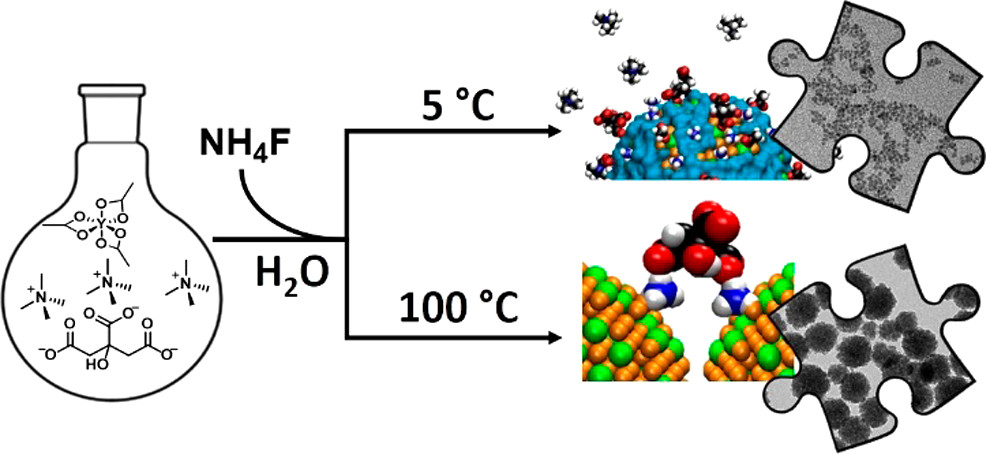
Ligand-to-surface interactions are critical factors in surface and interface chemistry to control the mechanisms governing nanostructured colloidal suspensions. In particular, molecules containing carboxylate moieties (such as citrate anions) have been extensively investigated to stabilize metal, metal oxide, and metal fluoride nanoparticles. Using YF3 nanoparticles as a model system, we show here the self-assembly of citrate-stabilized nanostructures (supraparticles) with a size tunable by temperature. Results from several experimental techniques and molecular dynamics simulations show that the self-assembly of nanoparticles into supraparticles is due to ionic bridges between different nanoparticles. These interactions were caused by cations (e.g., ammonium) strongly adsorbed onto the nanoparticle surface that also interact strongly with nonbonded citrate anions, creating ionic bridges in solution between nanoparticles. Experimentally, we observe self-assembly of nanoparticles into supraparticles at 25 and 100 °C. Interestingly, at high temperatures (100 °C), this citrate-bridge self-assembly mechanism is more efficient, giving rise to larger supraparticles. At low temperatures (5 °C), this mechanism is not observed, and nanoparticles remain stable. Molecular dynamics simulations show that the free energy of a single citrate bridge between nanoparticles in solution is much larger than the thermal energy and in fact is much larger than typical adsorption free energies of ions on colloids. Summarizing our experiments and simulations, we identify as key aspects of the self-assembly mechanism the requirement of NPs with a surface able to adsorb anions and cations and the presence of multidentate ions in solution. This indicates that this new ion-mediated self-assembly mechanism is not specific of YF3 and citrate anions, as supported by preliminary experimental results in other systems.

Epitaxial YBa2Cu3O7−x nanocomposite films and coated conductors from BaMO3 (M = Zr, Hf) colloidal solutions

X. Obradors, T. Puig, Z. Li, C. Pop, B. Mundet, N. Chamorro, F. Vallés, M. Coll, S. Ricart, B. Vallejo, F. Pino, A. Palau, J. Gázquez, J. Ros and A. Usoskin, Supercond. Sci. Technol. 2018 044001

DOI: https://doi.org/10.1088/1361-6668/aaaad7

Continue reading

Institut de Ciència de Materials de Barcelona ICMAB CSIC

Address

Campus de la UAB, 08193 Bellaterra, Barcelona, Spain
+34 935 801 853 ext 371 
hr_suman@icmab.es
